
Home Care for Your Parents in Lahore, Arranged From Anywhere in the World
London, Toronto, Dubai, Riyadh, New York, Sydney — the problem is the same. Your parents are in Lahore, something has changed, and you cannot be there.
This page is not a sales pitch. It is about how caring for parents from abroad actually works in practice — the emergencies, the time zones, the consent problem, the money, and the conversation nobody prepares you for when your father says he does not need anyone.
It is rarely the care itself. It is everything around it.
Finding somebody to sit with an elderly parent in Lahore is not the hard part. These are the things that keep overseas children awake at three in the morning, and almost all of them are logistical rather than medical.
Nobody can decide anything
The hospital needs consent. A caregiver cannot give it. You are asleep in another country. The decision waits, and waiting is the risk.
You hear about problems late
Parents downplay symptoms so you will not worry. By the time you are told, it has been going on for a fortnight.
Your parents refuse help
"Mujhe kisi ki zaroorat nahi." The care is arranged, paid for, and quietly turned away at the door.
Siblings disagree
Three children in three countries with three opinions, and one local relative doing all the running who is starting to resent it.
Money becomes awkward
Sending funds, hospital deposits, receipts that never arrive, and nobody wanting to look like they are checking up on family.
You cannot verify anything
You are trusting a stranger with your mother, from six thousand miles away, on somebody's recommendation.

Making the time difference work instead of fighting it
Most families phone whenever a free moment appears, which lands at odd hours in Lahore and produces rushed, polite answers. A fixed rhythm works far better. Pakistan Standard Time is UTC+5, and a written update sent at 9:00 pm Lahore time — after the evening medicines and the last meal — arrives at a sensible hour almost everywhere.
| Where you are | Update arrives | Best window to call Lahore |
|---|---|---|
| United Kingdom | 5:00 pm | Your 9:00 am = 1:00 pm Lahore |
| UAE — Dubai, Abu Dhabi | 8:00 pm | Your 9:00 am = 10:00 am Lahore |
| Saudi Arabia | 7:00 pm | Your 9:00 am = 11:00 am Lahore |
| US East Coast / Toronto | 12:00 noon | Your 9:00 am = 6:00 pm Lahore |
| US West Coast / Vancouver | 9:00 am | Your 9:00 am = 9:00 pm Lahore |
| Australia — Sydney | 3:00 am — take a morning update instead | Your 6:00 pm = 1:00 pm Lahore |
Times shift by an hour when daylight saving changes where you live — Pakistan does not observe it. For families in Australia and New Zealand we send the update in the Lahore morning instead, so it lands in your afternoon.
What happens at 3 am in Lahore while you are asleep
This is the fear underneath every other question, so it deserves a real answer rather than a reassuring phrase. An emergency plan is agreed before anything happens, and it settles five things.
- Which hospital. Chosen in advance based on your parent's condition and distance from the house, not decided in a panic. If they already see a consultant somewhere, that hospital usually wins.
- Who travels with them. The attendant on duty goes and stays. Nobody is left alone in an emergency department at two in the morning.
- Who is called, and in what order. Normally you first, then a named local relative as backup. If you do not answer within an agreed number of minutes, the next person is called automatically.
- Who can give consent. Families never plan for this one. A caregiver or an agency cannot consent to surgery or a procedure on your parent's behalf. If your parent is able to decide, they decide. If they are not, a family member must be reachable — which is exactly why a named relative in Lahore matters even when you are paying for everything from abroad.
- How the hospital deposit is handled. Private hospitals in Lahore usually require an advance before admission. Decide now who pays it, from which account, and how it is settled afterwards. Working this out at 3 am costs time you may not have.
Write the plan down. Share it with every sibling. Keep a printed copy at the house where any attendant on duty can find it. A plan that lives only in a WhatsApp thread is not a plan.
What a genuinely useful update contains
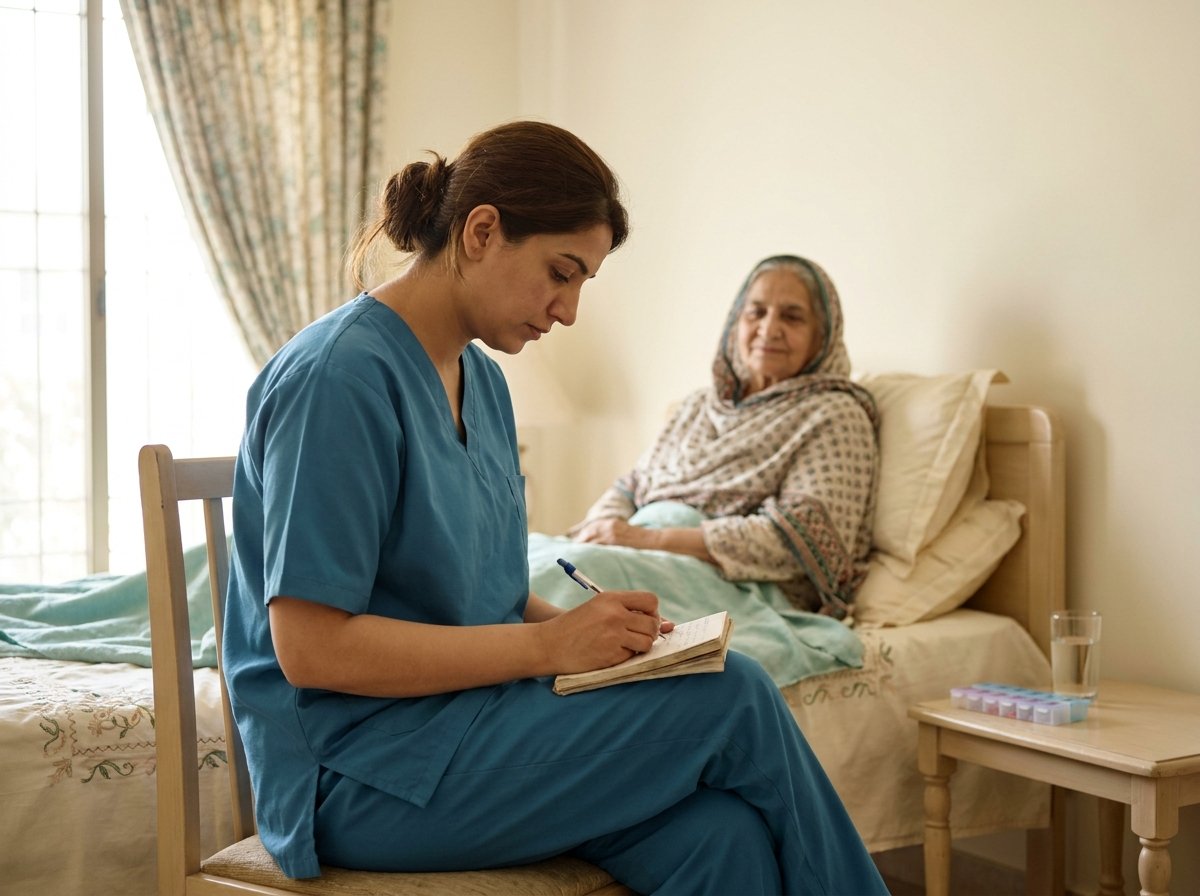
Every provider promises updates. Very few define them, and "Sir, everything is fine, Alhamdulillah" is not information. Insist on specifics — from us, or from anyone else you hire.
A daily update worth reading
- Medicines given, and the times they were actually given
- What was eaten, and roughly how much of it
- How the night went — sleep is an early warning sign
- Mobility: walked, sat up, or stayed in bed all day
- Mood and alertness compared with yesterday
- Anything new — pain, cough, swelling, confusion
Weekly, and after every appointment
- Weight, plus blood pressure or sugar if being tracked
- Photographs of any wound, rash or swelling being watched
- Photos of prescriptions and lab reports, not typed summaries
- What the doctor actually said, in their own words
- Medicines flagged before they run out, not after
- What changed this week, and what stayed the same
When your parents refuse the help you have arranged
This is the most common reason arrangements collapse in the first two weeks, and you will not find it mentioned on many care websites. Your father says he is not an invalid. Your mother does not want a stranger in her kitchen. The caregiver arrives on Monday and is politely sent home.
Change the framing
- Not "you need looking after" — help with one specific task they already find tiring
- Start with what they will accept: someone to accompany them to appointments, or to sort out medicines
- Frame it as your peace of mind rather than their weakness. Parents accept for a child's sake what they refuse for their own
- Let them meet the person before anything is agreed
Change the pace
- Begin with a few hours on a few days, not a live-in arrangement from day one
- Expect two or three weeks before it feels normal to them
- Keep the same person — a new face resets the resistance every single time
- Give your parent a say in gender, language and the daily routine
If the refusal is absolute and safety is genuinely at risk, that becomes a conversation for their doctor rather than an argument between you and them. Advice from a physician often lands where advice from a son does not.
The first month, week by week
Families abroad usually imagine care either works immediately or fails. In reality it settles over about a month, and knowing the shape of that month stops you panicking in week two.
Assessment and awkwardness
Everyone is polite and nothing feels natural. Your parent is on best behaviour, the caregiver is learning the household, and you will hear very little that is useful. This is normal. Focus on getting the written scope of work and the emergency plan agreed.
The wobble
This is when most arrangements are cancelled. Your parent says they do not need this, or complains about something small. Unless there is a genuine problem with the person, hold the line. Resistance in week two is about the change, not the caregiver.
Patterns appear
The updates start being useful because there is now a baseline. You begin to see what a normal day looks like, which is what makes an abnormal day visible later. Adjust the routine now — timings, meals, when the caregiver comes.
Review and settle
A proper review: is the level of care right, is it too much, is it not enough? Many families discover they need fewer hours than they feared, or that an attendant is enough where they had assumed a nurse. Others find the opposite. Either way, decide with a month of evidence rather than a week of anxiety.
How to check a provider from another country
You cannot walk into an office or look someone in the eye. So verify everything that can be verified, and stay sceptical about everything that cannot.
- Check nursing registration yourself. Nursing is a licensed profession in Pakistan. The Pakistan Nursing and Midwifery Council maintains an official register you can search by CNIC number to confirm somebody is currently licensed to practise. Ask for the CNIC of the person actually being sent — not a general assurance that "all our staff are registered."
- Ask about the specific person, not the company. Credentials belong to individuals. A company claim is not a credential.
- Video call the caregiver before they start. Five minutes will tell you a great deal about whether they can actually communicate with your parent.
- Have a relative visit unannounced in the first fortnight. Not to catch anybody out — to see an ordinary day rather than a scheduled one.
- Test the response time once, early. Message at an inconvenient hour and see what happens. Better to learn this in week one than during an emergency.
- Be wary of round numbers and awards. "Thousands of families served" cannot be checked. A registration number, a written scope of work and a contactable reference can be.
Siblings, money, and who is actually in charge
Appoint one decision-maker
- One sibling is the single point of contact for the care team; everyone else is kept informed
- A care team receiving three conflicting instructions cannot act quickly in an emergency
- Use a family group for updates, but keep one name on the file
- Agree in advance which decisions need everybody and which do not
- The relative in Lahore doing the running should be inside the loop, not bypassed
Keep money clean and boring
- Agree the monthly cost in writing before anything begins
- Pay the provider directly rather than handing cash to individuals
- Ask what is not included — medicines, labs, transport, equipment rental
- Keep receipts for anything bought on your parent's behalf
- Set a spending limit above which you must be asked first
- Never make one person responsible for both care and household cash
What overseas families most often call us about
Different conditions need different levels of care and produce very different monthly costs. These are the situations that come up most.
After a stroke
Positioning, feeding support, mobility work and preventing the complications that follow immobility. Usually the most intensive first three months. See stroke care at home.
Dementia and memory loss
Routine, safety and familiar surroundings matter more than clinical intervention. Continuity of the same caregiver is critical here. See dementia care at home.
After surgery
Wound care, medicines, watching for infection, and getting the patient moving again on the schedule the surgeon set. See post-operative care.
Simply getting frailer
No single diagnosis, just a parent eating less, walking less and falling occasionally. Often the case where families wait too long. See elderly care at home.
Cancer treatment
Support between hospital cycles — comfort, medication, nutrition and someone watching for side effects that need reporting. See cancer care and palliative care.
A carer who is exhausted
Frequently your sibling or your mother. Bringing in a patient attendant for part of the week protects the whole arrangement rather than replacing it.
What Alpha Care does for families abroad
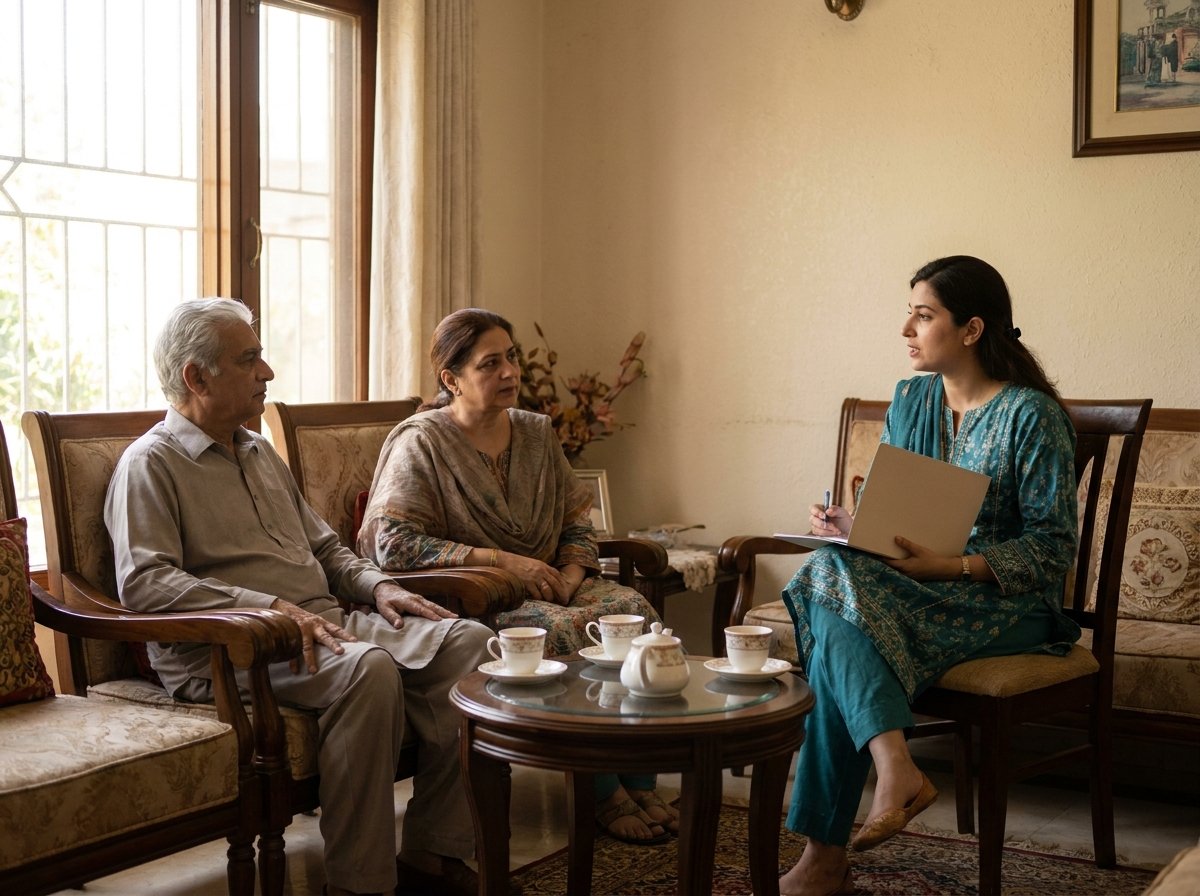
We are a home nursing service in Lahore. We do not run a hospital and we do not replace your parent's doctor. What we do is make sure the care between appointments actually happens, and that you know what is going on without having to chase it.
Assessment first
We visit, assess what the patient genuinely needs, and tell you honestly whether that is a nurse, an attendant or a caregiver.
You approve the plan
A written scope of work, the level of care, the hours and the full monthly cost. Nothing starts until you have agreed to it.
One coordinator
A named person who knows your parent's history and your concerns, so you are not re-explaining your situation every time.
Updates and review
Written daily updates at your agreed hour, a weekly review, and a plan that changes as the condition changes.
Getting the level right matters more than the amount. A nurse handles clinical work — medicines, injections, wound care, monitoring. A patient attendant supports daily living. Paying nurse rates for attendant work wastes money; doing the reverse puts your parent at risk. If the case needs continuous critical support, that is ICU care at home.
For a specific condition, see elderly care, dementia care, Parkinson's care, diabetes care, mental health care, physiotherapy at home and pediatric care.
What decides the level of care — and the cost
Any provider who quotes you a figure without asking about the three things below is guessing. Get the assessment first, then the quotation.
| Factor | Why it matters |
|---|---|
| Level of care | A registered nurse costs more than an attendant because the work is clinical. Have this assessed rather than assumed. |
| Hours | A 12-hour shift, two shifts covering 24 hours, or live-in — three very different arrangements at three very different costs. |
| Condition | A stable parent needing company and medicine reminders is not the same as a bedridden patient after a stroke. |
We give you a quotation once we understand the patient's situation, because a number given before an assessment is not a real number. Tell us the condition and the hours you think you need, and you will have a clear monthly figure to work with.
Whoever you use, ask for that figure in writing, and ask what sits outside it. Medicines, lab tests, doctor visits, transport and equipment rental are normally separate — that is standard practice, but you should know it at the start rather than discover it in month two. Contact us and we will talk it through.
Set things up while you are physically there
A week at home is worth six months of phone calls. If a trip is coming up, spend it on the things that are genuinely hard to do remotely.
- Meet the care team in person and watch an ordinary day rather than a performance.
- Sit in on one doctor's appointment so you understand the actual diagnosis rather than a relayed version of it.
- Photograph every document — prescriptions, reports, discharge summaries, ID — and store them where your siblings can reach them.
- Fix the house. Bathroom grab rails, loose rugs, poor lighting on the stairs. Falls are the single most common reason an independent parent stops being independent.
- Set up the technology. WhatsApp video working properly on their phone, contacts saved with names, volume loud enough for them to hear.
- Have the difficult conversation about what they would want if they became seriously unwell. Far easier face to face than down a phone line.
- Introduce the local backup relative to the care team, so they are not a stranger during a crisis.
Frequently asked questions
Can I arrange everything without coming to Pakistan?
The assessment, the plan, payment and the daily updates can all be handled remotely. What genuinely helps is one named relative in Lahore who can be physically present in an emergency and can give consent if your parent cannot. That is not a formality — hospitals need a family member, not an agency.
How do I pay from the UK, US, Canada, Australia or the Gulf?
Bank transfer, or the remittance channel you already use for family. Ask for the monthly amount in writing before the first payment, and a receipt after each one. Pay the provider rather than an individual caregiver — mixing personal cash with professional care creates problems for everybody involved.
What if the caregiver falls ill or does not turn up?
This is one of the main reasons overseas families use an agency rather than hiring privately. Ask any provider directly what their cover arrangement is and get the answer in writing. A private hire with no backup means your parent has nobody that day, and you are eight hours away.
Can you take my parent to hospital appointments?
Yes. Accompanying patients to appointments, waiting with them and reporting back what the doctor said is a standard part of the work. Ask for a photograph of the prescription and any report on the same day, not later.
My parents live with my brother. Do we still need this?
Often yes, and it is usually the sibling doing the caring who needs it most. Family carers manage until they suddenly cannot. Bringing in professional support for part of the week protects the whole arrangement rather than replacing it.
What if we are not satisfied with the person sent?
Ask for a replacement, and do it early rather than tolerating a poor fit for weeks. Fit matters more than families expect — language, temperament and the patience to sit with somebody who repeats themselves are not optional extras in this work.
Do you cover all areas of Lahore?
Yes — DHA, Gulberg, Johar Town, Model Town, Cantt, Bahria Town, Askari, Wapda Town, Garden Town and the surrounding areas. Tell us the address and we will confirm timing.
Can care be arranged at short notice for a hospital discharge?
Message us as soon as discharge is mentioned rather than on the day itself. Arrangements made in the final few hours are the ones that go wrong — the room is not ready, equipment has not arrived, and nobody has read the medicine list properly.
How quickly can care start?
That depends on the level of care and the assessment. Tell us the situation and we will give you a realistic timeline rather than an optimistic one. If we cannot staff a case properly, we will say so instead of sending somebody unsuitable.
Can we change the level of care later?
Yes, and most families do. Conditions change, and so should the plan. This is one of the practical advantages of using an agency rather than a private hire — moving from an attendant to a nurse should be a phone call, not a fresh search.
What languages do your staff speak?
Urdu and Punjabi are standard. Tell us your parent's preference before we match anybody — an elderly patient who cannot comfortably talk to their caregiver will not accept the arrangement, however well qualified that person is.
Do you provide female caregivers?
Yes. For many families this is not a preference but a requirement, particularly for personal care. Say so at the assessment stage and it will be matched accordingly.
Tell us what has changed
Message us with your parent's situation and where in the world you are based. We will tell you what level of care the case actually needs, what it costs, and how the updates will reach you — before you commit to anything.